
How to Optimize Your Content for AI Search (GEO) in 2026
Type a question into Google today, and there’s a good chance you get a complete answer before clicking a single link. Ask ChatGPT or Perplexity the same question, and the answer simply appears. The click may never happen.
This shift is called zero-click search, and it changes what visibility online actually means. The old goal “rank on page one and earn the click” is being replaced by a new one: “get chosen, cited, or summarized by the AI answering the question.”
This is where Generative Engine Optimization (GEO) comes in. It’s quickly becoming essential for any business trying to stay visible in 2026, whether that’s a large company or a solo consultant working with local clients.
What Is GEO, and How Is It Different from SEO?
Traditional SEO gets a human to click through to your page by optimizing titles, meta descriptions, and backlinks so a search engine ranks you higher.
GEO plays a different game with a different judge. You’re optimizing so AI systems Google’s AI Overviews, ChatGPT, Perplexity can understand, trust, and use your content when generating an answer for someone else.
- SEO asks: “Will a human click this link?”
- GEO asks: “Will an AI model understand this well enough to summarize it accurately?”
GEO doesn’t replace SEO it builds on it. Strong technical fundamentals still matter; GEO simply adds a new layer of consideration on top.
Why GEO Matters Right Now?
A growing share of searches are now answered directly inside AI tools, with no click at all. Someone researching a local service provider might get a summarized answer from an AI assistant and never visit a website directly unless that site is structured to be found and trusted by the AI in the first place.
The upside: when someone does click through from an AI-generated answer, they arrive with much higher intent, already informed by the summary. Traffic volume may shrink, but quality tends to rise.
This is also real opportunity for smaller businesses. GEO rewards clarity and demonstrable expertise, not advertising budget. A well-organized solo website can be summarized just as easily as a large agency’s, if the content is specific and well-structured.
Practical Steps to Optimize Your Content for AI Search
1. Structure Content for Easy Extraction
- Clear, descriptive headers stating exactly what each section covers
- Direct answers placed early, not buried under introductions
- FAQ-style sections mirroring how people actually phrase questions
- Short paragraphs and bullet points instead of dense blocks of text
Think of an AI skimming your page in seconds to answer someone else’s question. Make that job easy, or it moves to a competitor’s page instead.
2. Build Entity-Rich, Topically Deep Content
Rather than one broad post touching ten topics, go deep on fewer, connected ones. A cluster of focused posts each covering one specific subject and linking naturally to the others builds far more topical authority than a single post trying to cover everything at once.
AI systems trust sources that show real depth over shallow, scattered coverage.
3. Test How AI Tools Summarize Your Own Page
Ask ChatGPT or Perplexity to summarize a live URL from your site, then check:
- Did it get the facts right?
- Did it capture your main point, or miss it?
- Did it pull outdated or inaccurate information from elsewhere?
A thin or inaccurate summary signals your page needs clearer headers or more explicitly stated answers. Run this check periodically on your most important pages.
4. Strengthen Credibility Signals
- Add a genuine author bio with real, verifiable credentials
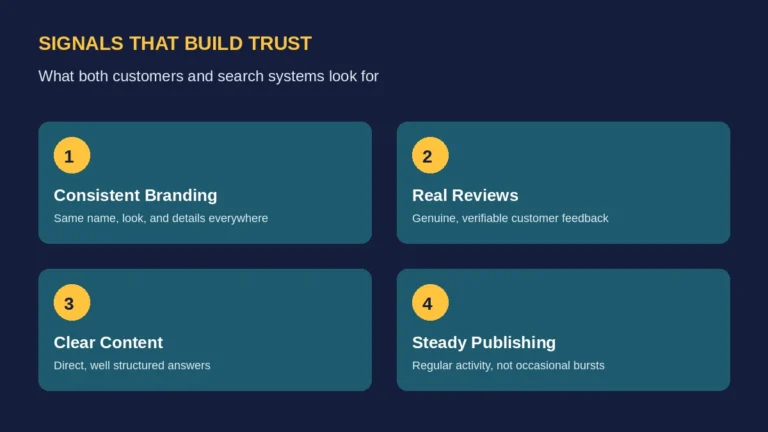
- Keep your business name and details consistent across your website, social profiles, and listings like Google Business Profile
- Publish on a steady schedule rather than in occasional bursts
An inconsistent or thin digital footprint makes AI systems more likely to favor a competitor that looks more established and easier to verify.
A Practical Example: Applying GEO at a Local Scale
Consider a freelancer building an independent client base in a specific region for instance, a freelance digital marketer in Alappuzha working primarily with small, local businesses. Instead of repeating a target phrase awkwardly across every page, a stronger GEO approach involves:
- Naturally mentioning the service and location across relevant pages, such as an About section, portfolio case studies, and service descriptions
- Including specific, verifiable details certifications, tools used, outcomes so AI systems have concrete facts to reference
- Structuring the site into clear sections: services, process, results, and contact
This clarity gives AI tools something solid to summarize and recommend. A freelancer who applies this consistently is far more likely to surface in an AI recommendation than one relying on outdated SEO tactics alone.
Quick Takeaway Checklist
- Use clear, descriptive headers throughout
- State the core answer early in each section
- Add a genuine FAQ section with real search phrasing
- Go deep on fewer topics instead of shallow coverage
- Periodically test key pages by asking an AI tool to summarize them
- Keep author bios and branding consistent everywhere
- Publish on a steady, sustainable schedule
- Avoid keyword stuffing; keep phrasing natural
Final Thoughts
GEO isn’t a replacement for SEO it’s the next layer on top of it. As more people get their first answer from an AI assistant, the businesses that structure content clearly, stay consistent, and demonstrate real expertise are the ones AI systems will choose to cite.
That’s an encouraging shift for small and independent businesses. It rewards clarity and authenticity over budget, which is a fight worth showing up for.